|
|
|
|
24–31 October 2026
This week in the deep sky
Welcome to the first issue! Every Friday: what the big space telescopes are looking at, the newest cosmic explosions and messages from deep space, and one object to find yourself. A three-minute read, with every item one click from the live sky map.
|
|
|
|
2
Hubble targets this week
|
|
|
166
supernova candidates on the map
|
|
|
632
IceCube alerts on the map
|
|
|
| |
? Telescope watch
Where the two great space telescopes are pointing, with a real sky image of each spot. |
|
|
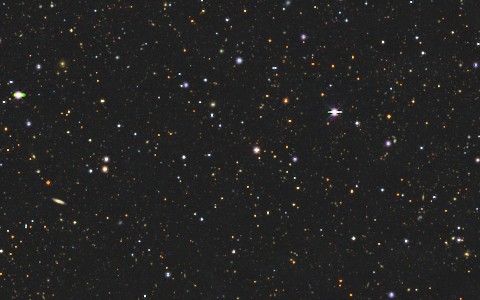
JWST · Sat 31 Oct
Panoramic-z15
“PHOENIX: the Emergence of Dust, Obscured Star Formation and ISM Physics at Cosmic Dawn” MIRI Low Resolution Spectroscopy On the map →
|
|
|
|
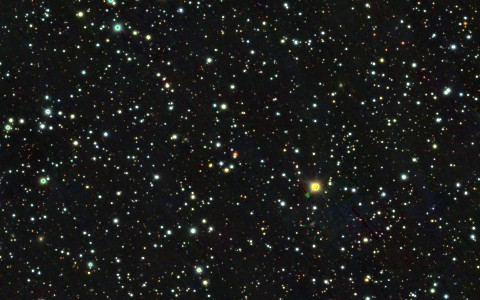
JWST · Sun 1 Nov
TOI-5205-BG
“A Parched Giant orbiting a Red Dwarf: Fact or Fiction?” MIRI Low Resolution Spectroscopy On the map →
|
|
|
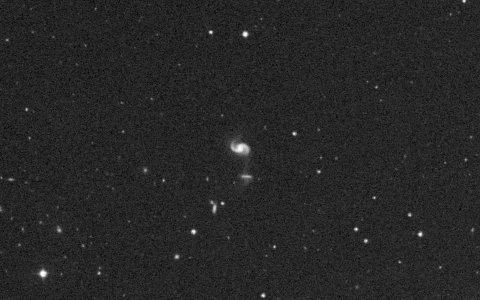
|
Hubble · Fri 30 Oct
MRK203
“Probing the Source of Extreme Nitrogen Enrichment in MRK 203” WFC3/UVIS On the map →
|
|
|
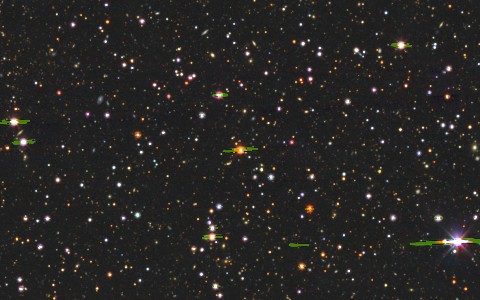
|
Hubble · Thu 29 Oct
TOI-1224
“STELa: Survey of Transiting Exoplanets in Lyman-alpha” STIS/FUV-MAMA, STIS/CCD On the map →
|
|
|
| Plans change at short notice; the JWST & Hubble layer on the map is updated daily. |
|
|
|
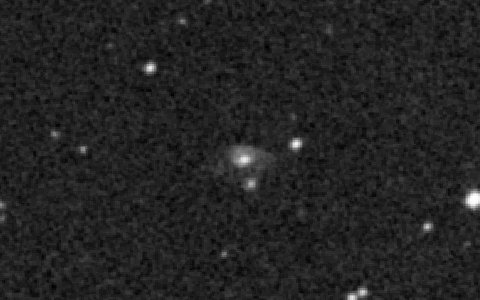
Supernova candidates
A quiet week
No new candidates in the ZTF survey. The latest, ZTF26acbepnu (Type II), appeared on 14 October: watch its light curve as it fades. Its light curve →
|
|
|
|
Gamma-ray bursts
None with a position this week
The most recent, GRB 261017A, went off on 17 October. Its X-ray afterglow faded within days. See GRB 261017A →
|
|
|
| |
? Messages from deep space
|
|
|
IceCube neutrinos
No new alerts this week
The latest was IceCube-261020A (Bronze, 20 Oct), and the latest Gold alert IceCube-261012A (12 Oct, 61% likely from deep space). A neutrino crosses the whole Earth almost untouched; once in a while one hits the Antarctic ice under IceCube and gives away where it came from. See IceCube-261012A's circle on the sky →
|
|
|
|
From the CHIME archive
FRB 20180916B
A source of fast radio bursts that flashed 19 times between September 2018 and June 2019. Each flash lasts a few milliseconds; a dispersion measure of about 349 pc/cm³ says how much gas the signal crossed, which puts it fairly close, in cosmic terms. All its bursts →
|
|
|
|
|
✨ Object of the week
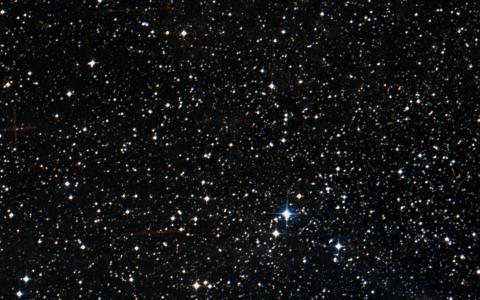
Vela Pulsar
One of the brightest pulsars in the gamma-ray sky and a frequent source of sudden rotation "glitches."
Pulsar · in Vela · ~959 ly (294 pc) away
Image: DSS2 colour survey (CDS)
|
|
|
? Term of the week
Redshift (z)
How much the universe has stretched light since it left the source. z = 1 means wavelengths have doubled; larger means farther and longer ago. Point at any underlined term on the site for more like this.
Every term in the glossary →
|
|
|
? Data corner
Free to download as spreadsheets, each with its source and how to cite it.
⬇ Neutrino alerts
⬇ Gamma-ray bursts
⬇ Supernova candidates
⬇ JWST & Hubble targets
|
|
Clear skies! Just reply to tell us what you'd like to see next.
|
You're receiving this because you signed up for This week in the deep sky at
portal.deepskymonitor.in.
Know someone who'd enjoy it? Forward this email; they can sign up at portal.deepskymonitor.in/newsletter.
Unsubscribe · Data: NASA, STScI, IceCube, CHIME/FRB, ZTF/ALeRCE, Swift, CDS.
Not for operational use.
|