Every number on this site comes from a spacecraft. Here they are: where each one is right now, what it measures, and where its data shows up on Deep Sky Monitor.
Orbits (TLE) 1 d oldDeep-space positions until
Above the Earth, live
--:-- · DAY AND NIGHT AS NOW
Dots: Earth-orbiting spacecraft (positions computed every 2 seconds from their orbital elements; the line behind each is its last 45 minutes). Diamonds: the point on Earth beneath a craft 1.5 million km away at L1 or L2, which is why the Sun-watchers gather under the Sun and JWST opposite it.
How far up?
LOG SCALE · LIVE
Each step on the scale is ten times farther. The space stations skim the top of the atmosphere; the weather satellites hang 36,000 km up, where an orbit takes exactly one day; Chandra swings a third of the way to the Moon; the L1 and L2 craft are four times farther than the Moon.
Along the Earth–Sun line
The Sun is 150 million km off to the left. L1 and L2 are the two points where the Sun's and Earth's pull balance a craft that keeps pace with Earth; nothing sits exactly on them: each craft loops around its point in a wide "halo" orbit, traced here from yesterday (solid) to the next two weeks (dotted). Positions: NASA JPL Horizons.
Around the Sun
SEEN FROM ABOVE THE PLANETS' PLANE
Parker Solar Probe and Solar Orbiter fly far from Earth, inside Venus's orbit, to see the Sun up close. Planet positions are approximate (circular orbits).
Years in space
LAUNCH TO TODAY
Completed missions
NO LONGER IN ORBIT
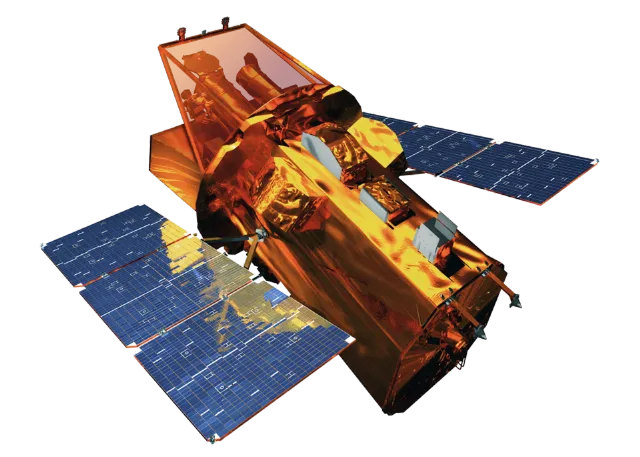
Neil Gehrels Swift Observatory 2004–2026
Re-entered Earth's atmosphere on 4 November 2026, after 22 years in space.
For 22 years, Swift's wide-field detector caught gamma-ray bursts, and within about a minute the whole spacecraft swung round to point its X-ray and ultraviolet telescopes at each one. The burst positions and X-ray light curves on Explore Deep Sky are Swift's.
What it measured stays on the site: its observations are kept in the archives it fed, and the map keeps the events it found.
Orbits: CelesTrak (TLEs, SGP4 via satellite.js) · deep-space positions: NASA JPL Horizons · Earth: NASA Blue Marble and Earth at Night (Wikimedia Commons) · spacecraft pictures: NASA, NOAA, ESA and others, credited under each picture.